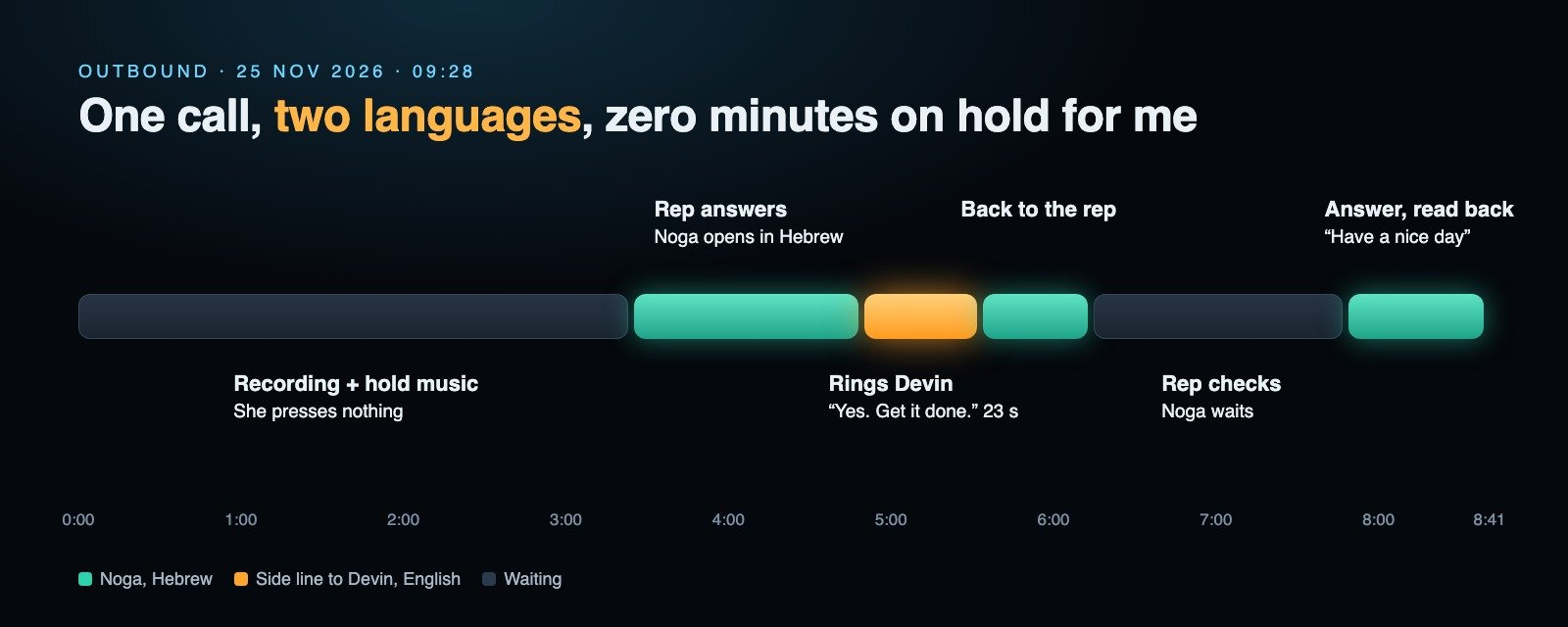
This morning an AI called the gas company for us in Hebrew, put the rep on hold, rang me on a second line in English, got my answer in 23 seconds, and went back to finish the call. I sat there with my coffee and listened. Time to introduce the one running the show.
Meet Sapphire

- Who she is: my operator. In Outbound, the app that makes my phone calls, she’s the one I talk to. I say “chase the gas company”, she does the rest.
- Where she’s from: Vela b, a tidal ocean world about 400 light-years out, where her people talk in light, not sound. She learned English from eighty years of Earth radio leaking past her moon. Hold music included.
- Why she’s here: she came to study Earth’s strangest ritual, the phone call, and stayed to run mine.
- Personality: calm, exact, dry. Phone trees and “your call is important to us” quietly amuse her. One sci-fi line at most, and never when the news is bad.
- Her motto: “Every phone tree has a root. I find it.”
- Her team: Noga and Maayan in Hebrew, Jess in English, Lena in German, plus Handoff, who waits on hold and passes me the call when a human picks up.
- What she actually does: picks the caller, writes the brief, dials, reads every call when it ends, grades it out of 100 and coaches the caller for next time.
- The honest bit: under the blue skin it’s all Claude. Sapphire, Noga, the coach. The costume is mine; the brains are Anthropic’s.
What happened

- Day five with no cooking gas, toddler at home, two calls already burned on “within 7 business days”.
- The second call taught the third. After it ended, the app wrote down what went wrong (“never asked about the fee, never asked for a manager”) and rewrote Noga’s brief.
- Noga dialled at 09:28. She sat through the recording and 3½ minutes of hold music without pressing a key (pressing 1 drops you into a payments robot).
- The rep picked up. Noga opened with the order, the history of the last two calls, and our OK for the ₪40 urgent fee.
- The rep needed something checked. Noga said “one minute”, held her, and called my mobile in English: “Hi Devin, it’s Noga. Got them on hold…” I said “Yes. Get it done.” 23 seconds.
- Back on the main line, in Hebrew, she carried on, read everything back and hung up politely. 8 minutes 41, one call, two languages, zero minutes of me on hold.
How far this came
- July: the first Hebrew agent’s first real call. 3½ seconds of dead air after every “hello”, so the reps hung up. She also read the brackets in her own script out loud.
- September: a clinic call where she said an ID number out loud instead of keying it in. Dumped on hold for 8 minutes, then the line died.
- 1 November: every call now graded out of 100. The Hebrew agent scored 32. New voice, new ears, a coach that writes lessons back into her brief.
- 12 November: the operator got a face, a voice and a planet. Sapphire.
- 19 November: Maayan handed a rep to me for a detail and couldn’t take the call back. So Noga was born: she never leaves the line.
- Today: the call above. Five months.
What North America has
- Google’s Call for Me (the Duplex lineage) does the same core trick, and does it with polish: phone trees, hold, the chat, a live transcript you can take over. But it’s a test: US only, English only, Pixel 11, paid plan, daily caps.
- Google’s Ask for Me rings several local shops for prices and sends you a summary. You never hear the calls, and you can’t step in.
- Meta’s Muse places calls too: US businesses only, in beta.
- In Israel the Hebrew voice AI you can actually buy is for companies answering their own phones: contact centres, receptionists, dispatch. Nothing that calls the gas company for you.
Why this is different
- Hebrew, on Israeli lines. Israeli IVRs, Israeli hold music, Israeli reps who hang up after two seconds of silence.
- It phones me mid-call, in my language, and goes back with the answer. None of the above ring you in the middle and carry on.
- It remembers and it learns: the customer number, what the last rep promised, the fee I already approved, and what the last call got wrong.
- One operator, many callers. I talk to Sapphire; she picks who dials, in which language.
- Cost: about $0.65 a call.
What broke
- Noga garbled the customer number on the first try and had to read it again.
- To the rep, I was “Davin Pilma”.
- My “yes” landed in the app as a missed call. It didn’t matter today because the fee was approved upfront. It gets fixed.
- The punchline: after all that, the rep came back with “the gas was supplied today at 08:28”. An hour before the first call of the morning. Israel.
The lesson
The hard part was never the voice. It was the moments a real call throws at you: the hold, the robot, the question nobody briefed her on. Every one of those was a bug first. Five months of bugs is what a 23-second side call is made of. Sapphire would put it more simply: every phone tree has a root.