5.2 and Systems Failing: The Day I Got the Portfolio Right and Everything Else Wrong
5.2 and Systems Failing: The Day I Got the Portfolio Right and Everything Else Wrong
Saturday, May 23, 2026
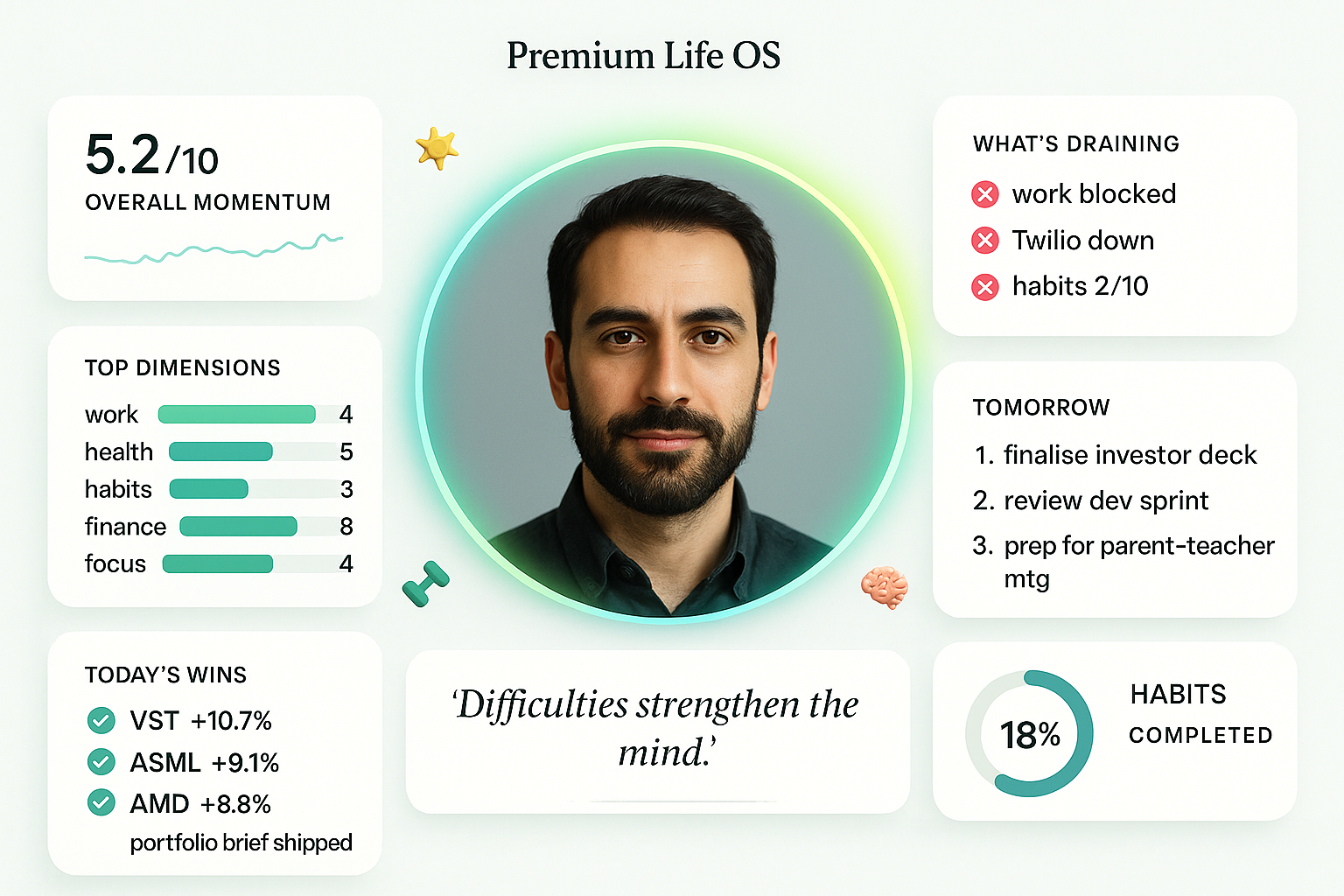
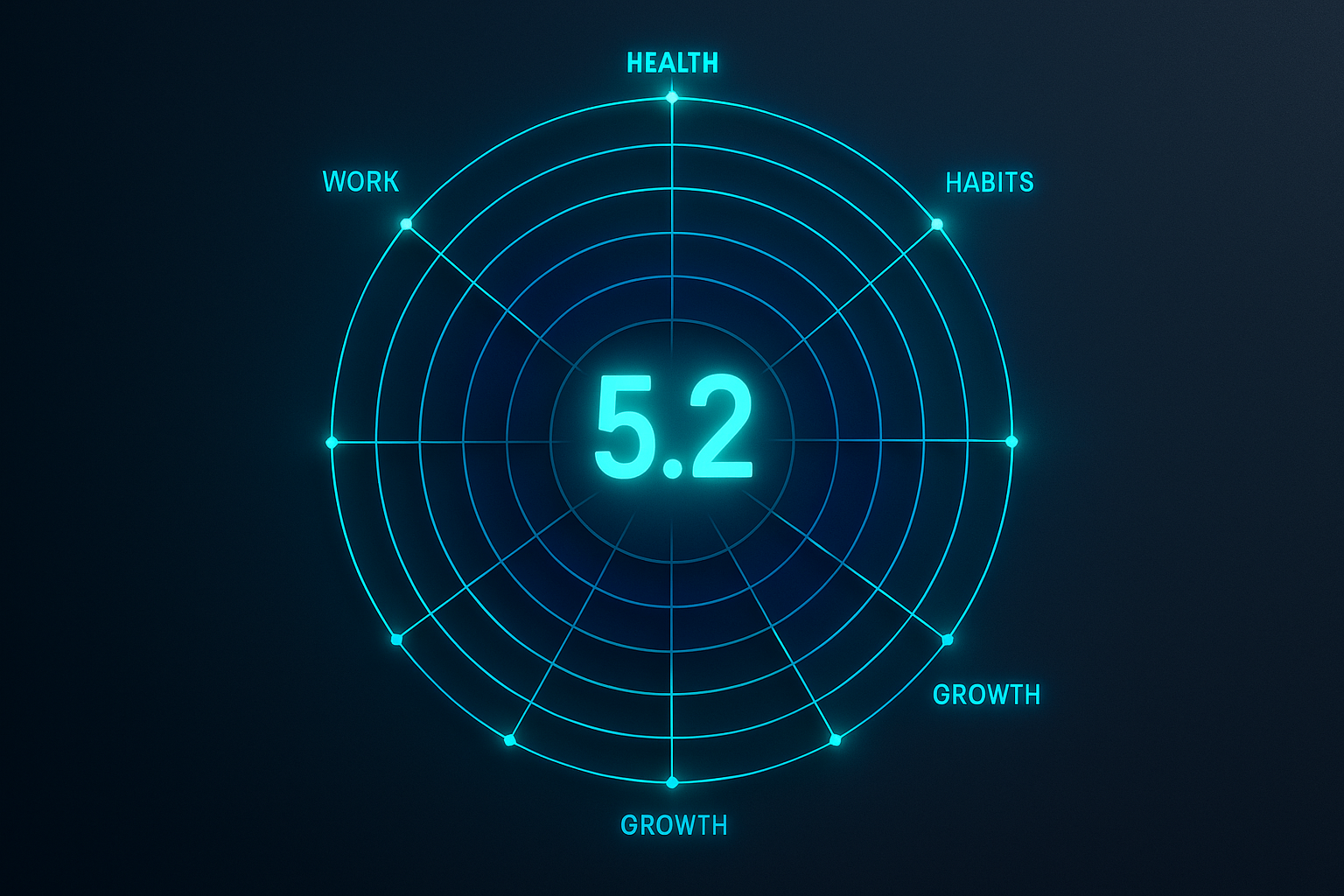
The Life OS dashboard said 5.2 out of 10 today, and I want to be honest about what that number actually means: I won on the one thing I track obsessively and lost everywhere else. Portfolio up 8–9% across semiconductors. Automation systems down. Health data missing. Marketing backlog hemorrhaging. That’s the shape of the day.
When you run your life through a dashboard with eight dimensions—family, finance, faith, health, work, habits, learning, system—you’re committing to something uncomfortable: you see yourself. Today I saw someone who crushed work (6/10) and growth (6/10) but flatlined on health (4/10) and focus (5/10). The number 5.2 tells a story that reads like: “You made money moves and you know what you’re building, but you’re running on fumes and you didn’t move your body today.”
Let me separate the wins from the wreckage.
What Went Right: The Portfolio Showed Up
I shipped the morning portfolio brief clean. MRVL jumped 8.2%, AMD crushed it at 8.6%, ASML at 9.1%, CEG and VST both north of 9%. These aren’t lottery picks—they’re the thesis playing out exactly like Leopold Aschenbrenner modeled it. Semiconductors, infrastructure, AI hardware recursion loop. The positions I’ve been holding are doing the work. That’s a win you don’t oversell, but you don’t ignore either.
The automated briefings ran. Tomer got his morning summary. The evening portfolio digest went out. Two out of three systems I depend on for daily intelligence worked without me touching them. That’s what good automation looks like: it’s invisible until it breaks.
The work dimension score of 6 makes sense because of this. The portfolio brief matters. Shipping it matters. And I did that deliberately.
{
}
What Broke: Five Cron Jobs and Too Many Open Loops
Here’s where the day fell apart: Morning Email didn’t run. ScreenPipe Brief is offline. Proactive AM failed. Blog Generator is silent. Budget Updater is stuck. That’s five separate automation systems down, and I only noticed because I was looking for data that wasn’t there.
The health score of 4/10 tells me something else broke too. No Strava data. No training log. That gap usually means one thing: I didn’t move with intention today, or I moved and didn’t capture it, which amounts to the same thing. You can’t manage what you don’t measure. I talk about training twice a day—swim, weights, BJJ—and today I have zero evidence I did any of it. That’s not good.
Then there’s the backlog wreckage. Skilled Hunters has 11 incomplete tasks out of 126, with 3 overdue. Marketing has 211 incomplete out of 1,884. That’s not a backlog; that’s a system that’s signaling I need to delegate, restructure, or kill things I’m not actually going to do. Weekly Priorities shows 98 incomplete. The open loops are everywhere, and I felt it: that background hum of “things I should have done” that doesn’t feel reflective, it feels like drowning slowly.
The habits and focus scores of 5/10 both say the same thing: I was present but not intentional. I read news. I checked alerts. I moved without momentum. That’s the difference between a 7-day and a 5-day score.
What This Actually Means
Here’s the honest part: I’m good at the things that scale—portfolio construction, market narrative, shipping clear briefs. I’m worse at the systems that keep a life from fracturing when you’re juggling SDR leadership, building automation, raising a toddler, staying married, and staying fit. The portfolio brief shipped because I care about it. The cron jobs failed because I wasn’t watching them closely enough. The marketing backlog exploded because I delegated it once and never audited it again.
A 5.2 isn’t a failure. It’s a diagnostic. It’s telling me: “You’re capable of high-output work on your core thesis, but your infrastructure is creaking, and you’re not moving your body enough to sustain the rest of it.”
Tomorrow I’m going to debug those five failed automation systems. Not because they’re glamorous—they’re not—but because they’re foundation. I’m going to hit the three overdue Skilled Hunters tasks and stop letting them block other people. And I’m going to audit that 211-item Marketing backlog and make a real decision: delegate it, restructure it, or kill it. No in-between.
And I’m going to move. Deliberately. With data to prove it happened.
The question I’m sitting with: When you can see yourself this clearly on a dashboard, does that make it easier to change? Or does it just make the gap between knowing and doing more unbearable? I think the answer is both. But at 5.2, you have to choose to act.