This morning my phone company and my home line provider both put my bills up, with no warning. I didn’t want to spend my day on hold, so I handed both to my AI callers with one instruction: get me the best deal, and they don’t deal with me at all. By the evening the companies had made that impossible, and Noga had learned a new move to get around it.
TL;DR
- The ask: Partner and Bezeq both raised prices. My agents fight it, I stay out of it.
- What broke: the first caller kept handing the rep to me. Then both companies refused to talk to an assistant at all, even with my ID.
- What got built: a no-transfer switch, “open cases” that any call-back lands on, and a three-way where Noga pulls me in for 30 seconds and carries on.
- Honest status: the rejoin is tested. The first run with a real rep is still to come.
Meet Noga

- Who she is: my Hebrew caller in Outbound, the app that makes my phone calls. Errands, sign-ups, account changes, anything in Israel where an ID might come up mid-call.
- Her story: grew up in Rehovot, did her army service on a switchboard where nobody was allowed to hang up on a general, then eight years getting quotes out of insurers. She lives in Tel Aviv and collects rotary phones.
- Her one rule: you never hand the phone away and lose the call. She holds the line, gets the answer, comes back.
- Her line: “One moment, I’m checking that with Devin, it’ll take a minute.”
- The honest bit: she’s Claude in a costume, like every agent in the fleet. The voice, the story and the rotary phones are mine.
Round one: the bot that kept calling me
- Maayan went first. She’s my other Hebrew caller. She reached real reps at both companies, and each time she did the polite thing: “one moment, I’ll put Devin on.” Exactly what I said I didn’t want.
- The brief wasn’t the problem. It said, clearly, keep me out of it. But the bot had a transfer button in its kit, and a rep who pushes hard enough gets the button.
- The fix: a per-call “no transfer” switch. A matter I’ve handed over gets no transfer tool at all, so there’s nothing to press. Hebrew calls on these matters now go to Noga.
Round two: open cases
- A case is a matter handed over for good. It holds the goal, the account facts, what Noga may agree to on her own, and every call so far.
- Her limits are written down: a lower price for the same service, no longer than 12 months, no fees. She never cancels anything and never adds a service.
- Any call-back lands on her. Whatever number the company rings back from, the call reaches Noga with the whole file. No “who is this about?”
- The companies were told by email to deal with my assistants from now on.
Round three: the wall
- Both companies said no. Not to the deal: to the assistant. Privacy rules say the account owner speaks himself.
- Even the ID didn’t do it. Noga has a side line: she keeps the rep on hold, rings me for one detail like an ID number, and carries on. She did that. The answer was still “only the owner.”
- A twist I found later: one of the Bezeq calls was made on a number that turned out not to be my account at all. The refusal was right; the file was wrong. Fixed in the case.
- The rule makes sense. I’d want a company to say exactly that to a stranger calling about my account. So the answer wasn’t to argue. It was to bring me in for the one thing only I can do.
Round four: bring Devin
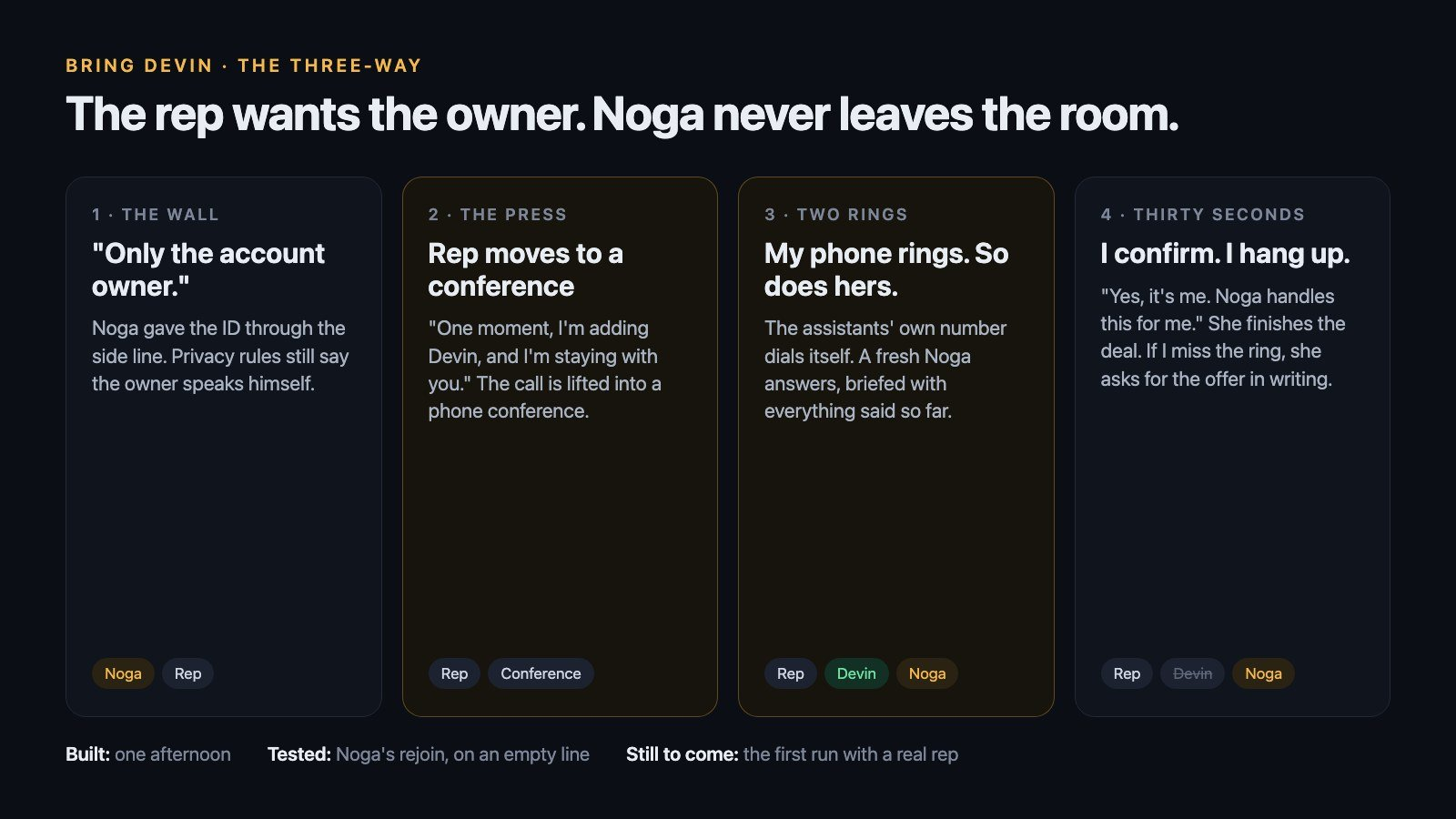
- When a rep insists on the owner, Noga says “one moment, I’m adding Devin to confirm, and I’m staying with you”, and presses one button.
- The rep is moved into a phone conference. My phone rings into the same room.
- The clever part is how she comes back. The original call ends when the line moves, so the assistants’ own number dials itself into the conference, and a fresh Noga answers. She’s briefed with the case and everything said so far, and she speaks first.
- I do about 30 seconds: “Yes, it’s me. Noga handles this for me.” Then I hang up, and she finishes.
- If I miss the ring, she tells the rep I couldn’t join, asks for the full offer in writing and how I can authorise her in writing, and closes politely.
- What’s proven: the self-dial and the rejoin brief, on an empty test line. What isn’t: a real rep in the room. That’s the next call.
And a scoreboard
- Every agent’s profile now lists its skills, each rated 1 to 5, Learning to World-class, with one line of proof. New abilities get a new row the day they ship.
- Noga’s include “side line to you” at 5, “brings you in, stays on” at 4, and “price-backs and retention” at 3: she knows her limits, and her first wins there are still to come.
- A competence score comes out of the skills, and the team is ranked on skills plus graded calls.
- The table: Jess, my executive assistant, on top at 9.8. Noga at 9.0.
What I learned
- Look at what a bot is allowed to do, not just what it’s told. The instruction said keep me out. The toolkit said transfer. The toolkit won.
- A wall can be a good rule. The companies were right to refuse an assistant. The fix was to design for the rule, not around it.
- Bring the human in for the smallest possible job. Thirty seconds of “yes, it’s me” beats twenty minutes of hold music.
- Check the file before the call. A perfect caller on the wrong account still gets nowhere.
- Say what’s tested. The pieces work. The whole thing hasn’t met a real rep yet.
Next
- The first live three-way, the next time a rep asks for the owner.
- Noga’s retention skill, from a 3 to something better, one call at a time.