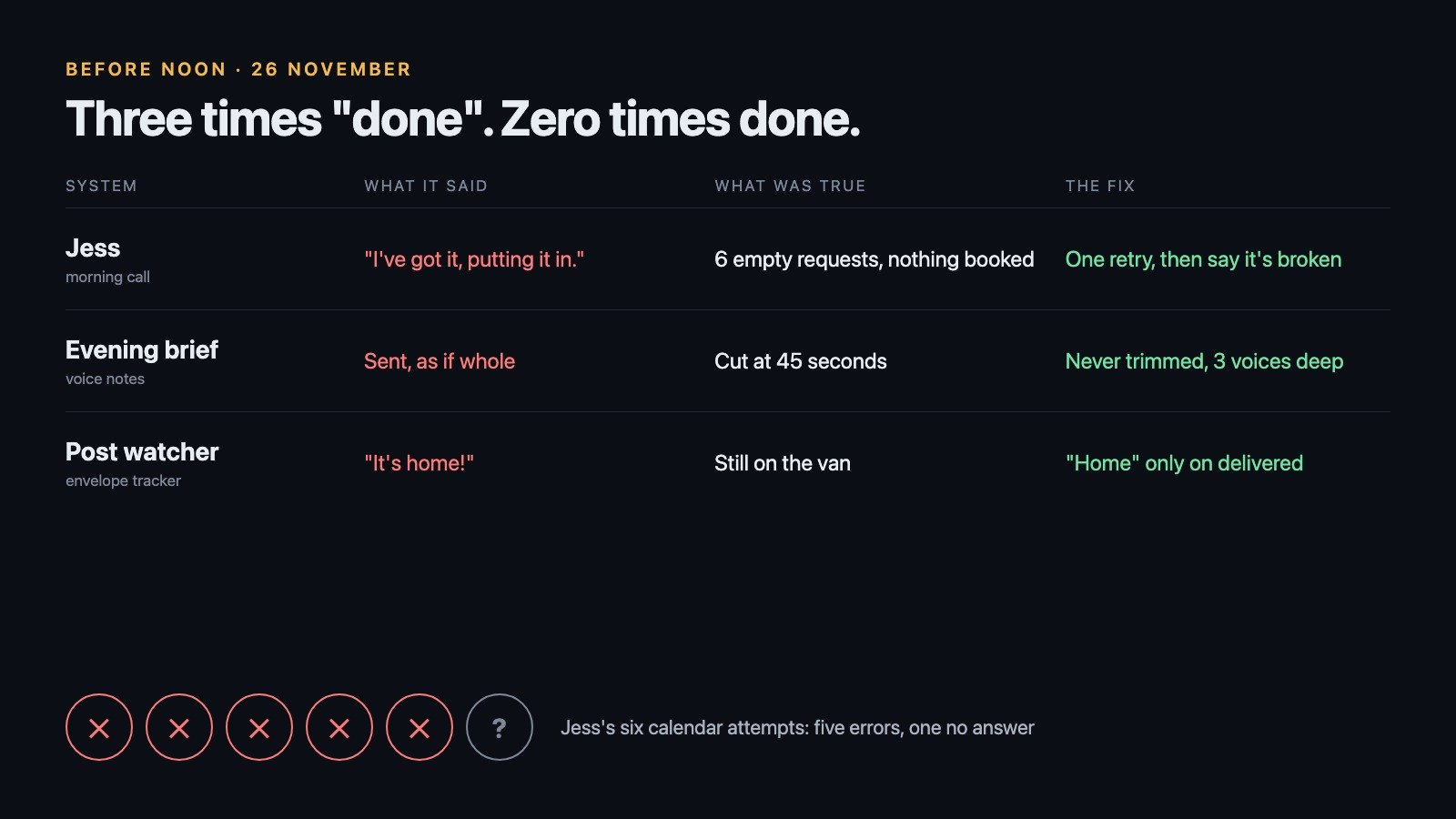
Building a new app is the fun day. This is the other kind. Before noon today, three different systems told me a job was done when it wasn’t. Each one was fixed by lunch, and each one taught the same lesson. First, the one on the cover.
Meet Jess

- Who she is: the voice that calls me in the morning. One call, a couple of minutes: the day’s big picture, what needs me, what can wait.
- What she can do: read my calendar and inbox, and act on a yes. Book the slot, send the note, then say “Done.”
- Personality: warm and sharp. One joke, then business.
- How she improves: every call is read back and graded, and the lessons go into a playbook she carries into the next call. Today’s is version 15.
- The honest line: she’s Claude under the costume, like every agent here.
Fault 1: “One sec.” Then nothing
- On the morning call I agreed to one thing: put a call in my calendar for Monday afternoon.
- She said “One sec.” and “I’ve got it, putting it in.” Nothing was booked.
- Two test calls later we found it. She tried to create the event six times, and every attempt went out empty: no title, no start, no end. Five came back with an error. She said nothing about any of it.
- She also read an afternoon slot back to me as “05:15”.
- The grade: last week C+, today D+.
The fix
- Every calendar request carries the full set: title, start, end, description. No exceptions.
- One retry, never a third. If it fails twice she says so in one line and sends me the details in writing.
- No “putting it in” unless it’s in. She may only say done after the tool says done.
- Times in words: “Monday, quarter past five in the afternoon.” Never “05:15”.
- Still open: the last test call ended before an event was confirmed. The next real call is the exam.
Fault 2: the bedtime brief that stopped at 45 seconds
- Every evening two voice notes go out: mine in English, my wife’s in Hebrew. Last night both stopped after about 45 seconds.
- Cause: the monthly voice budget was 99% spent, and a safety rule trimmed the notes to fit what was left. It trimmed them quietly.
- Fix: a note is never trimmed. If the main voice can’t afford it, a second voice reads it in full, and a third stands behind that one.
- The second voice turned out to be at its own cap today, so the third one read. Both notes went out again at full length: 4:14 and 3:32.
Fault 3: “It’s home!” It wasn’t
- A watcher tracks an important envelope in the post and messages me when it lands.
- This morning it announced the envelope was home. It was on a van.
- Cause: it read “out for delivery” as “delivered”. In Hebrew the two statuses share a root word.
- Fix: out for delivery gets its own message. “Home” is only said when the post office says delivered.
Also on the night shift
- A system update moved a sync button to a different screen, and the script that presses it went looking in the old place. It now finds the button by where it sits and checks the label before it clicks.
The lesson
- A loud failure is cheap. An error I can see gets fixed in ten minutes.
- A quiet “done” is expensive. I walk away believing it, and I find out days later, at the worst moment.
- So the rule for every agent and script: no success without proof. Say done only when the system you asked says done. Otherwise say what broke, in one line, and hand it to me.
Next
- The next morning call: does the calendar event actually appear?
- The same “prove it” check on every other tool Jess can use.